

Red and near-infrared light shows a real, measurable signal for knee osteoarthritis pain, with reviews pointing to 785–860 nm and 904–905 nm as the ranges most likely to help. Evidence for rheumatoid arthritis is far weaker and mostly inconclusive. Most documented benefits are short-term pain reduction, not structural repair, and this therapy works best alongside a clinician’s guidance, not in place of one.
TL;DR:
- Wavelengths of 785–860 nm and 904–905 nm are most supported by research for knee osteoarthritis pain relief, while evidence for rheumatoid arthritis remains inconclusive.
- Short-term pain reduction is the primary benefit shown in trials, with no substantial evidence of structural joint repair or long-term disease modification.
- Effectiveness depends on proper dosing within a biphasic dose-response curve, meaning excessive or insufficient light exposure can nullify or reverse benefits.
- Consumer-grade LED devices may not replicate the efficacy of clinical laser protocols used in studies, emphasizing the importance of matching device specifications to research findings.
- Red light therapy should be viewed as a complementary symptom management tool, best combined with physical therapy, movement, and medical guidance.
Table of Contents
- Does Red Light for Joint Pain Actually Work? The Biology Behind It
- What Clinical Research Actually Shows for Arthritis Pain
- Choosing a Device: Wavelengths, Dosing, and Form Factors That Match the Research
- How to Use Red or Near-Infrared Light on a Joint at Home
- Safety, Who Should Avoid It, and What to Actually Expect
- Beyond Arthritis: Tendonitis, Bursitis, and Other Joint-Adjacent Pain
- What Happens With Continued Use Over Weeks and Months
- How Red Light Compares to Physical Therapy, Medication, and Injections
- Which Tranquilora Device Fits Your Joint Pain Routine?
- Key Studies and Reviews to Read Next
- Sources
- FAQ
Does Red Light for Joint Pain Actually Work? The Biology Behind It
The honest answer starts at the cellular level, not the marketing page. Red and near-infrared light doesn’t “heal” a joint the way a bandage covers a cut. It interacts with a specific structure inside your cells called cytochrome c oxidase, an enzyme sitting in the mitochondria that acts as a light-sensitive gatekeeper for energy production.
Here’s the mechanism in plain terms: when red or near-infrared photons reach that enzyme, they knock loose a bound nitric oxide molecule that had been slowing it down. With nitric oxide out of the way, the mitochondria can process oxygen more efficiently and produce more ATP, the molecule your cells use as fuel. Mechanistic reviews describe this as the primary plausible pathway by which photobiomodulation influences cellular activity, including changes linked to inflammation control and tissue repair signaling.
That extracellular energy doesn’t automatically mean less pain. But researchers believe the downstream effects, including modulated inflammatory signaling and improved local circulation, are what show up in trials as reduced stiffness and discomfort around a joint. It’s a plausible chain of events, not a guaranteed outcome.
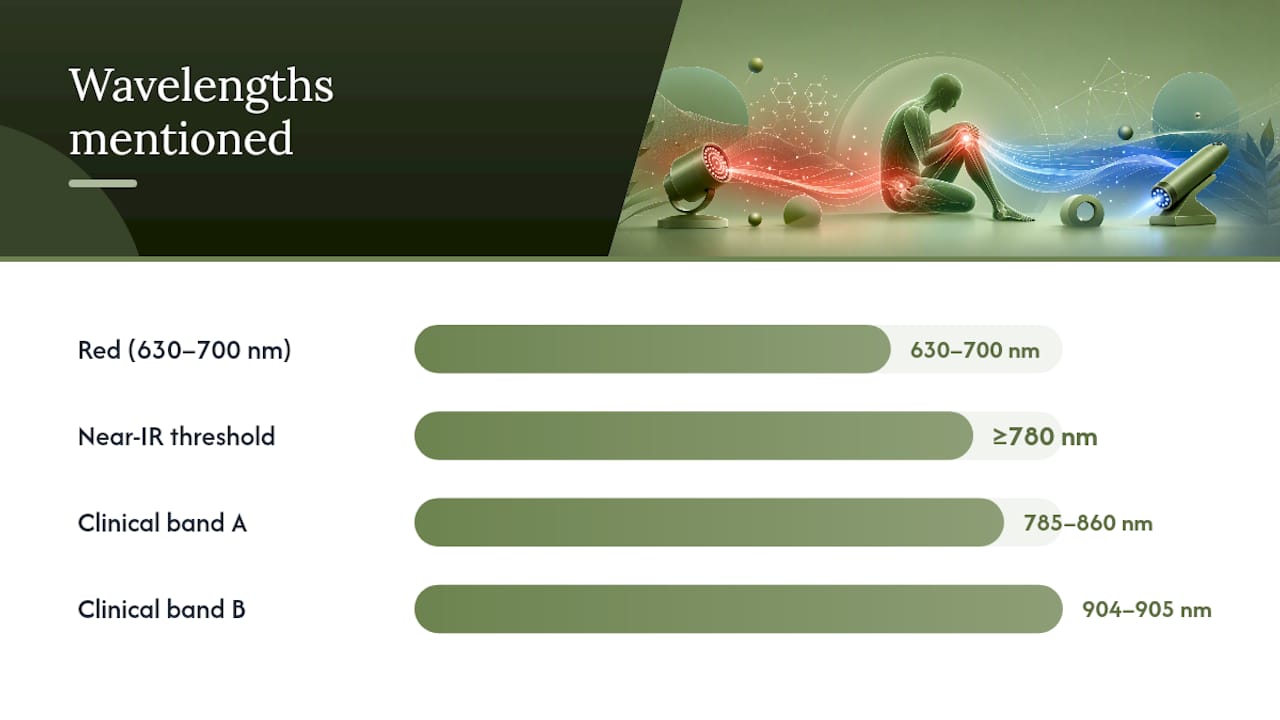
Wavelength matters here more than most people realize. Red light in the 630 to 700 nm range penetrates skin and shallow tissue well, but joints like the knee or shoulder sit under layers of skin, fat, and muscle that scatter shorter wavelengths before they reach the target. Near-infrared light, generally 780 nm and above, travels deeper with less scatter, which is why so many joint-focused trials favor it over standard red light alone.
A concept called the biphasic dose-response curve also shapes how this technology is used. It works like this:
- Low to moderate light doses tend to stimulate mitochondrial activity and produce the intended benefit.
- Doses that are too low may produce no measurable effect at all.
- Doses that are too high can flip the response, actually suppressing the cellular activity researchers are trying to encourage.
This biphasic pattern, documented across photobiomodulation dosing literature, is the reason more light and more time are not automatically better. It’s also why credible devices and protocols specify exact session lengths rather than leaving exposure open-ended.
Quick fact: The wavelengths most consistently linked to knee osteoarthritis pain relief in clinical research sit in two narrow bands: 785–860 nm and 904–905 nm, according to a large network meta-analysis of light therapy trials.
Think of it less like a light switch and more like watering a plant. The right amount at the right frequency supports growth. Too little does nothing. Too much can do harm.
What Clinical Research Actually Shows for Arthritis Pain
Evidence quality is not uniform across arthritis types, and that distinction matters more than any single statistic in this field. Knee osteoarthritis has a genuinely encouraging research base. Rheumatoid arthritis does not.
The knee osteoarthritis evidence
A systematic review and network meta-analysis pooling 32 randomized controlled trials and 2,078 participants found low-level light therapy outperformed sham treatment for knee osteoarthritis pain. The 904–905 nm wavelength range ranked highest for potential pain-reduction efficacy, and 785–860 nm also showed meaningful signals. That’s a substantial body of trial data by physical-therapy research standards, and it’s the strongest evidence base this therapy has for any joint condition.
A separate network meta-analysis of physical modalities for knee osteoarthritis placed low-level laser therapy among the more effective noninvasive interventions when compared against exercise programs and other physical treatments. That ranking doesn’t mean light therapy beats exercise outright. It means light therapy holds its own in a crowded field of nondrug, nonsurgical options, which is a meaningful finding given how few noninvasive treatments for knee OA show consistent benefit across multiple trials.
The catch, and it’s an important one, is evidence certainty. Reviewers consistently rate this evidence as low or moderate certainty rather than high certainty. That grading reflects real limitations in the underlying studies:
- Trial protocols vary widely in wavelength, dose, session frequency, and duration, making direct comparisons difficult.
- Many trials are small, some with fewer than 50 participants per arm.
- Most supportive trials used clinical-grade lasers, not consumer LED panels or wraps.
- Blinding is imperfect in several studies, since participants can sometimes tell whether a device is active.
None of that erases the signal for knee OA. It does mean “low-level light therapy reduces knee pain more than sham treatment in trials” is a fair statement, while “red light therapy cures arthritis” is not one any credible review supports.
The rheumatoid arthritis picture looks different
Rheumatoid arthritis is a systemic autoimmune condition, distinct from the wear-and-tear mechanics of osteoarthritis, and the research reflects that difference. A systematic review and meta-analysis of controlled trials covering 18 randomized trials and 793 participants found low-quality evidence that infrared laser therapy was not clearly superior to sham treatment for RA pain, morning stiffness, or joint function.
That’s a meaningfully different conclusion than the knee OA data. It doesn’t prove light therapy does nothing for RA. Small sample sizes, inconsistent protocols, and heterogeneous outcome measures across the included trials mean the evidence simply isn’t strong enough to draw a confident conclusion either way. For someone managing rheumatoid arthritis, that uncertainty is a reason to treat red light as, at most, a complementary comfort measure discussed with a rheumatologist, never a substitute for disease-modifying treatment.
Pain relief, function, and stiffness aren’t the same outcome
One detail readers often miss: “joint pain relief” isn’t one single measurable thing in these trials. Researchers typically track pain scores, functional mobility (how well someone climbs stairs or walks a set distance), morning stiffness duration, and, far less often, structural changes visible on imaging.
Most of the positive knee OA findings apply specifically to pain scores over weeks to a few months. Function improvements show up less consistently. Structural change, meaning actual cartilage or joint-space improvement, has essentially no supporting evidence in current human trials. If a session template or product description implies otherwise, that’s outrunning what the research actually shows.
Data snapshot: Across many trials analyzed for knee osteoarthritis, wavelengths near 904–905 nm tended to rank highest for pain improvement, although the overall certainty of the evidence remains low; this nuance is important when setting expectations.
Choosing a Device: Wavelengths, Dosing, and Form Factors That Match the Research
Translating a research paper’s protocol into a shopping decision takes some interpretation, but a few specs matter more than the rest.
Wavelength is the first thing to check on any product listing. Trials showing the clearest pain-reduction signals for knee osteoarthritis cluster around 785–860 nm and 904–905 nm, both in the near-infrared range rather than visible red. A device that only emits standard red light around 630 to 660 nm may still offer general wellness benefits for skin-level tissue, but it isn’t matched to the depth needed to influence a knee or hip joint the way the OA trials describe. Many home devices, including panels sold under Tranquilora’s red light therapy collection, combine red and near-infrared diodes specifically to cover both shallow and deeper tissue in one session.
Irradiance, measured in milliwatts per square centimeter (mW/cm²), tells you how much light energy reaches the skin per second at a given distance. Fluence, sometimes listed as joules per point or joules per square centimeter (J/point or J/cm²), tells you the total dose delivered over a session. Practitioner protocols commonly target roughly 4 to 8 joules per point at 785–860 nm, or 1 to 3 joules per point at 904 nm, for knee osteoarthritis treatment. A device with lower irradiance needs a longer session to reach the same fluence, so “10 minutes” means very different things on two different devices.
Pro Tip: Check whether a product lists irradiance at a specific distance, like 3 or 6 inches. Irradiance drops sharply as you move a panel farther from the skin, so a device rated for 100 mW/cm² at 6 inches will deliver far less at 12 inches, even if the session timer stays the same.
Form factor is where personal fit matters most, and there’s no single right answer.
- Panels cover a broad, flat area and work well for larger joints like the knee, since you can position the whole panel over the joint without adjusting mid-session.
- Wraps and wearables contour to a specific joint, which makes them convenient for the shoulder or elbow and lets you move around the house during a session instead of sitting still in front of a panel.
- Mats cover multiple joints or a full limb at once, which suits people managing pain in several areas rather than one isolated joint.
One caveat that applies across every form factor: nearly all of the strongest clinical trial data comes from clinical-grade lasers, not consumer LED devices. A review of LED-based photobiomodulation notes that researchers still call for more LED-specific randomized trials, since laser and LED light sources differ in coherence and beam concentration even when wavelength and dose are matched on paper. That doesn’t mean LED devices are ineffective. It means the specific performance data from laser trials shouldn’t be assumed to transfer perfectly to every LED panel on the market. For a broader look at what to check before buying, the guide on choosing a light therapy panel walks through spec comparisons in more depth.
How to Use Red or Near-Infrared Light on a Joint at Home
Before any session, run through a short mental checklist. This isn’t about being overly cautious for its own sake. It’s about making sure the therapy fits your actual health situation.
- Confirm your diagnosis first. Joint pain has many causes, from mechanical wear to autoimmune disease to referred pain from another structure entirely. A clinician can confirm what you’re actually treating before you build a routine around it.
- Check for photosensitizing medications. Certain antibiotics, acne medications, and other prescriptions increase skin sensitivity to light. Review your medication list with a pharmacist or doctor if you’re unsure.
- Flag any implanted electronic devices. Pacemakers and similar devices warrant a conversation with your cardiologist before starting any light therapy routine near the chest or torso.
- Note pregnancy or active cancer near the treatment site. Both situations call for a direct conversation with your treating physician before use, since safety data specific to these groups is limited.
- Start with a conservative session template. Based on ranges reported across knee OA trials, many home protocols use sessions of 10 to 20 minutes, panels positioned 6 to 12 inches from the skin, three to five sessions per week, sustained for 4 to 8 weeks before assessing any change. These are ranges drawn from trial patterns, not personalized medical instructions.
- Position the device for your specific joint. For a knee, a panel angled directly at the joint while seated works better than trying to hold a wrap in place. For a shoulder or elbow, a wrap that stays put during light movement tends to be more practical than a stationary panel. Details on session spacing are covered in this guide to how often to use red light therapy.
- Pair it with movement, not instead of it. Randomized trial data on combining photobiomodulation with other physical modalities, including interferential current therapy for knee osteoarthritis, found better outcomes than light therapy used alone. Physical therapy, stretching, or a clinician-guided exercise program remains the better-established foundation, with light therapy as a possible addition.
- Know your stopping rules. Discontinue and consult a clinician if you notice no improvement after several weeks of consistent use, if pain worsens, or if you notice any skin irritation, redness, or unusual reaction at the treatment site.
Pro Tip: Keep a simple pain log, rating discomfort on a 0 to 10 scale before starting and once weekly during your routine. Trial data on pain relief spans weeks, not single sessions, so a log helps you judge honestly whether the pattern is trending down or just staying flat.
Safety, Who Should Avoid It, and What to Actually Expect
The safety profile reported across reviews is generally favorable for low-level light therapy, with adverse events reported infrequently in trial data. That said, “generally low-risk” is not the same as “risk-free for everyone.”
Eye protection deserves specific attention with higher-intensity panels, since direct exposure to concentrated light sources, particularly near-infrared wavelengths you can’t see or sense as brightness, can affect the eyes without an obvious warning sign. Most panel manufacturers recommend keeping eyes closed or shielded during sessions near the face or upper body.
Several groups warrant a clinician conversation before starting:
- Anyone taking photosensitizing medications, including certain antibiotics and retinoid-based prescriptions.
- Anyone who is pregnant, given the limited safety research specific to this population.
- Anyone with active cancer at or near the treatment site.
- Anyone with an implanted electronic device, such as a pacemaker or defibrillator.
Clinical guidance from major medical centers, including Cleveland Clinic’s overview of red light therapy, consistently frames this therapy as one piece of a broader care plan rather than a standalone treatment, and recommends discussing it with a healthcare provider before starting, especially for anyone managing a chronic condition.
It’s worth restating what the current research supports and what it doesn’t. The evidence points toward short-term pain reduction for knee osteoarthritis specifically. It does not currently support claims of disease modification, cartilage regrowth, or long-term structural improvement. One more practical distinction: wellness devices sold for home use are not the same regulatory category as cleared medical devices used in clinical trials. Checking a product’s actual labeling and intended use claims before buying helps set expectations that match reality rather than marketing language.
Beyond Arthritis: Tendonitis, Bursitis, and Other Joint-Adjacent Pain
Joint pain doesn’t always originate in the joint itself. Tendonitis, an inflamed tendon connecting muscle to bone, and bursitis, inflammation of the small fluid-filled sacs that cushion joints, both produce pain that feels joint-centered even though the tissue involved sits just outside the joint capsule.
The proposed mechanism for photobiomodulation stays consistent across these conditions: mitochondrial stimulation and modulated inflammatory signaling in the affected tissue, the same pathway described for osteoarthritis. What changes is the depth and location of the target tissue. A tendon running close to the skin surface, like the Achilles tendon, may respond to shallower wavelengths more readily than a joint capsule buried under muscle.
Direct trial evidence specific to tendonitis and bursitis is thinner than the osteoarthritis research base, and most existing studies are smaller and less consistently designed. That means the reasoning here is more extrapolated from general photobiomodulation mechanisms than confirmed by dedicated large trials. Anyone dealing with a tendon or bursa issue should treat red light as a possible complementary approach, not a substitute for the rest, activity modification, or physical therapy that’s typically recommended for these conditions.
What Happens With Continued Use Over Weeks and Months
Most of the available data tracks outcomes over a few weeks to a few months, which leaves genuine long-term evidence thin. Trials showing knee osteoarthritis pain improvement generally measured results across 4 to 8 week treatment windows, with some follow-up assessments extending a few months beyond that.
What’s less clear is what happens after a year or more of consistent use, or whether benefits persist once someone stops treatment altogether. Reviewers haven’t identified strong evidence either way on structural joint changes over extended periods, and no major review claims light therapy alters the underlying progression of osteoarthritis or arthritis over time.
The realistic framing: think of this as a maintenance tool for symptom management within a broader routine, similar to how you’d think about regular stretching or a foam roller, rather than a one-time fix with lasting structural results. People managing chronic joint conditions often continue sessions indefinitely because the pain-relief pattern in trials tends to track with continued use, not a single course of treatment. That’s a reasonable way to approach it, paired with regular check-ins with a clinician to track how the joint itself is doing over time, not just how the pain feels week to week.
How Red Light Compares to Physical Therapy, Medication, and Injections
Red light therapy occupies a specific niche among joint pain treatments, and it’s worth being clear about where it fits rather than letting it compete head-to-head with options it was never designed to replace.
Physical therapy remains one of the better-established interventions for knee osteoarthritis, with a stronger and more consistent evidence base than light therapy alone. Combined-treatment trial data, including studies pairing photobiomodulation with other physical modalities, consistently outperform light therapy used in isolation. That points toward light therapy working best as an addition to a movement-based program, not a replacement for it.
Over-the-counter and prescription medications, including NSAIDs, work through entirely different mechanisms and typically act faster on acute pain flare-ups than light therapy’s gradual, session-based approach. Medication decisions should stay with a physician, particularly given interaction risks and the need to weigh long-term use against side effects.
Corticosteroid or hyaluronic acid injections offer a more immediate, targeted intervention for some osteoarthritis patients, with effects that clinicians can measure and adjust more precisely than a home light therapy routine. Light therapy isn’t positioned as a substitute for injections when a clinician recommends them. It’s better understood as a lower-intensity, ongoing option someone might use between other interventions, always with a treating provider aware of the full picture.
Which Tranquilora Device Fits Your Joint Pain Routine?
Matching a device to the joint you’re actually treating makes a bigger difference than most people expect, and the research on session parameters points toward a few sensible pairings.
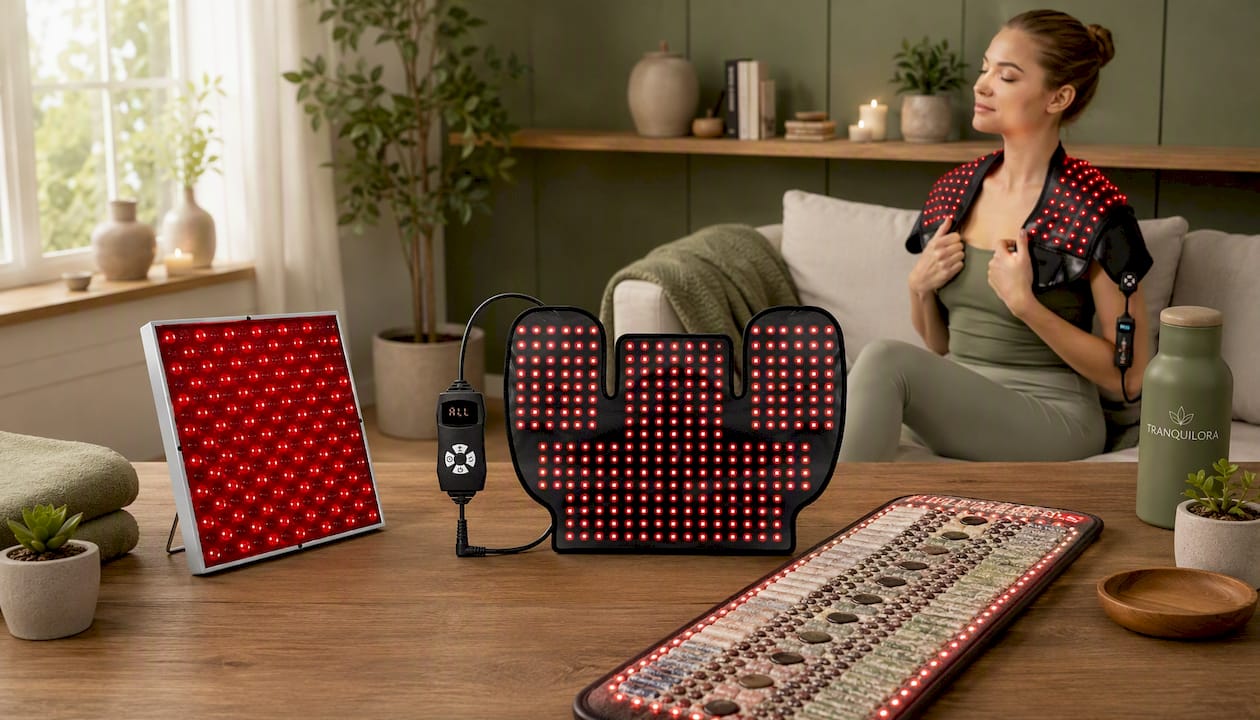
For shoulder or elbow pain, the Premium Red & Infrared Light Therapy Shoulder Wrap contours directly to the joint and stays in place during light movement, which suits a joint that’s awkward to hold still in front of a stationary panel. Its wearable design also makes it practical for people who want to keep a consistent session schedule without carving out dedicated sit-still time every day.
For knee pain specifically, where the strongest clinical evidence for photobiomodulation currently exists, the Premium LED Red Light Therapy Panel offers a larger, flat treatment surface that’s easier to position consistently at the same distance session after session, a detail that matters given how much irradiance changes with distance.

For anyone managing discomfort across multiple joints or a full limb at once, such as combined knee and hip pain or general lower-body stiffness, the Premium Gemstone Infrared Red Light Therapy Mat provides broader coverage in a single session rather than requiring you to reposition a smaller device multiple times.
Tranquilora’s approach has always been education first: choose based on which joint you’re targeting, how portable you need the device to be, and how many sessions per week fit your actual routine, not the other way around. Browse the full red light therapy collection to compare wattage, wavelength, and coverage area side by side, and remember that every option here is a wellness device meant to support a broader self-care routine, not a substitute for a clinician’s diagnosis or treatment plan. If you’re ready to build out a fuller at-home recovery setup, Tranquilora’s recovery and massage collection rounds out a routine that pairs light therapy with other supportive tools.
Key Studies and Reviews to Read Next
For readers who want to dig into the primary research directly, a few sources stand out for depth and rigor. The network meta-analysis on optimal LLLT wavelength for knee osteoarthritis offers the clearest picture of which wavelengths show the strongest signal. The rheumatoid arthritis systematic review provides necessary balance on where evidence remains weak.
For the underlying biology, the cellular mechanism review of photobiomodulation explains the cytochrome c oxidase pathway in more technical detail. And for general safety framing before starting any routine, Cleveland Clinic’s clinical overview remains a solid, accessible starting point.
Sources
- A systematic review and network meta-analysis on the optimal wavelength of low-level light therapy (LLLT) in treating knee osteoarthritis symptoms
- Effects of low-level laser therapy in adults with rheumatoid arthritis: A systematic review and meta-analysis of controlled trials
- Mechanisms of photobiomodulation (PBM) at the cellular level
- Physical modalities for the treatment of knee osteoarthritis: a network meta-analysis
FAQ
What does Cleveland Clinic say about red light therapy?
Cleveland Clinic frames red light therapy as a treatment with some early supporting research for specific uses, but recommends consulting a healthcare provider before starting, particularly for anyone managing an existing chronic condition. It positions the therapy as a potential complement to standard care, not a replacement for it.
What is the downside of red light therapy?
The main downsides are limited high-certainty evidence, inconsistent trial protocols, and a research gap between clinical laser studies and consumer LED devices. Reviewers rate most supporting evidence for knee osteoarthritis as low to moderate certainty, and evidence for rheumatoid arthritis has not shown clear benefit over sham treatment.
Can you overdo red light therapy for joints?
Yes. Photobiomodulation follows a biphasic dose-response pattern, where doses beyond the optimal range can reduce or reverse the intended cellular benefit rather than amplify it. Sticking to manufacturer-recommended session lengths and distances helps avoid overshooting an effective dose.
Who cannot use red light therapy?
People taking photosensitizing medications, those who are pregnant, anyone with active cancer near the treatment site, and people with implanted electronic devices like pacemakers should consult a clinician before use. These groups face either unknown or elevated risk based on current safety guidance.
Does red light help knee pain more than other joint conditions?
Current evidence is strongest for knee osteoarthritis, where multiple systematic reviews show light therapy outperforming sham treatment for pain. Evidence for rheumatoid arthritis and other joint conditions remains considerably weaker and less consistent.
Recommended
- Which Red Light Therapy Device Is Right for You?
- How Often Should You Use Red Light Therapy? A Beginner’s Guide
- Premium LED Red Light Therapy Panel
- Premium Red & Infrared LED Light Therapy Shoulder Wrap
This article is for general informational and educational purposes only and is not medical advice. Consult a qualified healthcare professional regarding health conditions or before making significant changes to your wellness routine.