

Red light therapy, also called photobiomodulation or low-level laser therapy (LLLT), can increase hair density for people in the early to moderate stages of pattern thinning when used consistently for several months. It does not regrow hair on scalps where follicles have gone dormant for years. Clinical trials on LED caps found compliant users gained an average of 28.5 more hairs per square centimeter than the sham group at 16 weeks. The best evidence applies to androgenetic alopecia, and results tend to build slowly.
TL;DR:
- Red light therapy shows modest but measurable hair density improvements mainly over 16 to 26 weeks of consistent use, with an average gain of 28.5 hairs per square centimeter for compliant users.
- Devices that directly part hair, such as combs and caps, deliver the most effective scalp light dose, with higher diode counts and dual-wavelength options improving results.
- Applying therapy daily for at least 10 minutes, preferably over several months, and maintaining regular sessions are key to seeing benefits, while stopping therapy reverses gains.
- The therapy works best for follicles that are still active but thinning, not for fully dormant or scarred follicles, and its results are influenced by hair color, thickness, and device design.
- Photobiomodulation is safe for daily use with minimal side effects, but benefits rely on consistent application, and treatment should be paired with other hair loss approaches for optimal outcomes.
Table of Contents
- Does Red Light Therapy Work for Hair Loss?
- How Does Photobiomodulation Work on Hair Follicles?
- Which Device Type Delivers Light to the Scalp Best?
- How Long Before You See Results from Red Light Therapy?
- Who Actually Benefits from Red Light Therapy for Hair?
- Is Red Light Therapy Safe for Daily Use?
- What Does Red Light Therapy for Hair Cost?
- How Do You Maintain Results After Red Light Therapy?
- What Do People Get Wrong About Red Light Therapy for Hair?
- Choosing a Home Red Light Device for Hair Support
- Sources
- FAQ
Does Red Light Therapy Work for Hair Loss?
The clinical record on red light for hair loss is more solid than most wellness trends, but it comes with real boundaries worth understanding before you invest time or money.
A double-blind, randomized controlled study testing a dual-wavelength LED cap found that participants who stuck to the protocol saw meaningful gains. That compliance threshold matters. It tells you the therapy’s benefit shows up mainly in people who actually use the device as directed, not occasionally when they remember.
Earlier research backs this up with different device formats. Trials using comb-style and helmet devices, reviewed in a broader analysis of LLLT for hair loss, reported statistically significant increases in hair count and thickness in both men and women with androgenetic alopecia, with some studies showing modest average gains in hair density after 24 to 26 weeks. The timelines vary by device and protocol, but the pattern holds: gains show up gradually, not overnight, and they cluster around the 16 to 26 week window across most trial designs.
A systematic review covering light-based therapies for alopecia looked at 63 relevant studies and found that red and near-infrared wavelengths consistently stimulate follicular cells and improve density in androgenetic alopecia. The same review flagged a real limitation: dosing protocols differ widely from one device and study to the next, and long-term durability data beyond a year or two remains thin.
Trial snapshot: In the pooled LED cap analysis, the compliant group’s average gain of 28.5 hairs/cm² over 16 weeks was the headline number, but it only applied to the subset who hit 80% compliance. That distinction between “intent to treat” and “per protocol” results shows up across most LLLT trials.
Here’s how the evidence breaks down by strength:
- Strongest evidence: androgenetic alopecia (pattern thinning) in both men and women, backed by multiple randomized, sham-controlled trials.
- Moderate evidence: consistent mechanism-level support for red and near-infrared wavelengths stimulating follicular activity across several alopecia subtypes.
- Weaker evidence: long-term durability past one to two years, and outcomes for less common hair loss conditions outside classic pattern thinning.
Stanford Medicine’s review of the research notes that red light therapy is genuinely evidence-backed for hair growth when used consistently, though in-clinic devices often deliver more power than at-home units, and the benefit tends to fade if someone stops treatment. That last point deserves attention: photobiomodulation looks more like an ongoing maintenance habit than a one-time fix.
What does a 20 to 28 hairs per square centimeter change actually mean in practice? It’s a modest but measurable increase in density, roughly the kind of shift that shows up in close-up scalp photography or a dermatologist’s densitometry reading, not usually a change visible from across a room after a few weeks. Think of it as slowing and partially reversing thinning rather than restoring a full head of hair from a receded state.
How Does Photobiomodulation Work on Hair Follicles?
Red and near-infrared light doesn’t act like a drug that binds to a receptor. It works through a more basic cellular mechanism: photon absorption by mitochondria.
The light gets absorbed by an enzyme called cytochrome c oxidase, sitting in the mitochondria of scalp cells. That absorption boosts the cell’s production of ATP, the molecule cells use as energy currency. Follicle cells with more available energy appear better equipped to stay in the active growth phase of the hair cycle, called anagen, rather than shifting prematurely into the resting or shedding phases.
A second mechanism involves nitric oxide. Red and near-infrared wavelengths can trigger the release of nitric oxide bound to cellular proteins, which in turn supports local blood flow. Better microcirculation around the follicle means more oxygen and nutrients reaching the tissue that needs them, along with modulation of growth factors involved in the hair cycle.
The wavelengths that matter here fall into two bands:
- Red light, roughly 630 to 680 nanometers: the range most associated with superficial follicle stimulation.
- Near-infrared, roughly 800 to 830 nanometers: penetrates slightly deeper into scalp tissue.
Photobiomodulation also follows what researchers call a biphasic dose response. Too little light does nothing measurable. Too much light can actually inhibit the same cellular processes it’s meant to support. This is part of why matching your device’s session time to its documented specifications matters more than assuming “longer is better.”
Direct scalp dosing turns out to be a bigger factor than most people expect. Hair itself blocks a surprising amount of light before it ever reaches the follicle. According to ISHRS clinical resources, even a modest amount of hair can cause a 32% to 37% reduction in light transmission to the scalp. That’s why device design, not just wavelength, ends up shaping real-world results.
Pro Tip: Part your hair into small sections before a session if your device isn’t a comb style. Every bit of scalp you expose directly to the light improves the odds you’re getting close to the dose used in clinical trials.
Which Device Type Delivers Light to the Scalp Best?
Not all red light devices are built the same way, and the differences matter more for hair loss than for most other uses of photobiomodulation.
Combs and brushes use teeth or bristles to physically part hair as you move the device across your scalp, placing diodes in close or direct contact with skin. This design directly addresses the transmission-loss problem: parting hair before the light hits it means less energy gets absorbed or reflected by hair shafts before reaching the follicle.
Headbands wrap around the scalp and typically combine several diode strips. They offer decent coverage of the crown and temples but usually sit close to hair rather than parting it, so results depend heavily on hair density and how the band is positioned.
Caps and helmets distribute diodes across a dome-shaped frame that fits over the whole scalp. These were the device category used in several of the largest randomized trials, including the dual-wavelength cap study that reported the 28.5 hairs per square centimeter finding. Caps trade direct scalp contact for even, whole-scalp coverage in a single session.
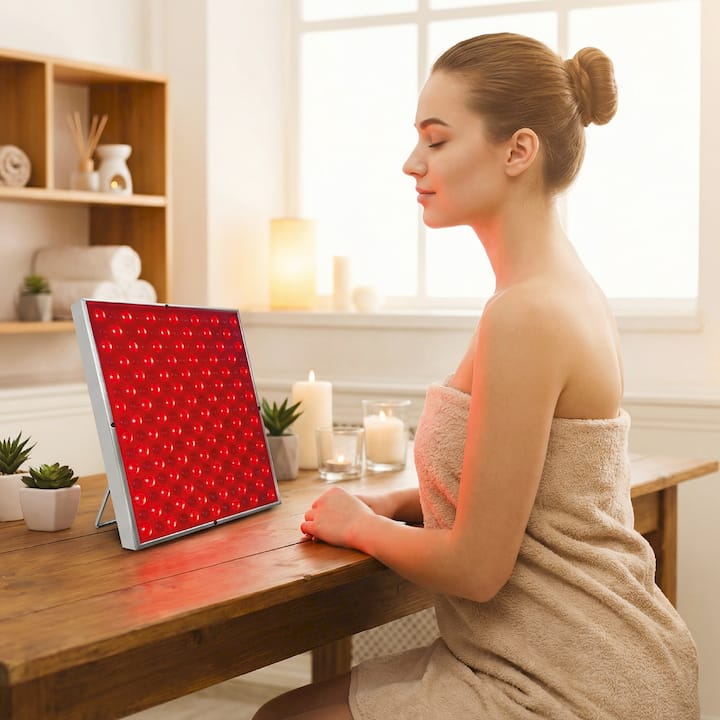
Panels are the most versatile format, useful for facial skin, joints, and broader body areas, but they’re a remote-delivery method for hair. Light has to travel further and pass through more hair before reaching the scalp, which is why panels tend to work better as an adjunct to skin or recovery routines than as a dedicated hair-density tool. Tranquilora’s Premium LED Red Light Therapy Panel fits this broader-use category well for people who want red light benefits across skin and muscle recovery alongside any hair-focused device.
A few practical factors separate a device that delivers a meaningful dose from one that mostly delivers a warm glow:
- Diode count and density: more diodes per square inch generally means more consistent coverage across the treatment area.
- Dual-wavelength design: devices combining red and near-infrared light aim to address both superficial and slightly deeper follicle tissue.
- Contact versus remote delivery: comb and cap styles that sit close to or against the scalp tend to outperform panels for hair-specific dosing.
- Ergonomics: a device you’ll actually use for months matters more than one with impressive specs you abandon after two weeks.
How Long Before You See Results from Red Light Therapy?
Consistency drives outcomes with photobiomodulation more than almost any other variable in the research. The trials that reported the clearest hair-count gains all shared one thing: participants who stuck close to the protocol saw results, and those who didn’t largely didn’t.
Typical study regimens looked like this:
- Daily short sessions. The dual-wavelength LED cap trial used 10-minute daily sessions.
- Slightly longer, less frequent sessions. Other trials used sessions ranging from 13 to 25 minutes, applied daily or every other day depending on the device.
- Sustained duration. Most trials ran 16 to 26 weeks before measuring outcomes, meaning participants used their device for four to six months minimum before researchers evaluated hair counts.
- Compliance tracking. Studies commonly required 80% adherence to count a participant in the primary analysis group, which is roughly 13 to 14 sessions out of every 16 scheduled.
Researchers behind the dual-wavelength LED cap trial built it into the study design because sporadic use simply didn’t produce measurable gains in earlier photobiomodulation research. If you’re using a device three or four times a month instead of most days of the week, you’re not approximating what the trials tested.
Building a short, repeatable daily window tends to work better than an ambitious plan you’ll abandon by week three.
Pro Tip: Take a photo of the same section of scalp under the same lighting every four weeks. Hair density changes are gradual enough that day-to-day comparisons won’t show anything, but a four-week interval often will.
One caveat worth repeating: device irradiance varies significantly across products. A 10-minute session on a high-output cap and a 10-minute session on a lower-power comb are not equivalent doses. Whatever device you choose, match your session length to the manufacturer’s specified protocol rather than assuming the study timelines above transfer directly to every product on the market.
Who Actually Benefits from Red Light Therapy for Hair?
Photobiomodulation works best on follicles that are still alive but struggling, not on scalp where follicles have been dormant for years.
The clearest candidates have early to moderate pattern thinning, where follicles have miniaturized (grown progressively finer and shorter over successive hair cycles) but haven’t disappeared entirely. Photobiomodulation appears to prolong the active growth phase and support follicle metabolism in this population. Clinical commentary suggests it works best as a modality that stabilizes and modestly improves density, not one that produces dramatic regrowth in areas that have been fully bald for a long stretch of time, since photobiomodulation cannot revive follicles that are already fibrosed or absent.
A few other factors shape who’s likely to see meaningful change:
- Hair color and thickness affect light transmission. Thicker or darker hair absorbs and scatters more light before it reaches the scalp, which is part of why device choice (comb versus panel, for example) matters more for some people than others.
- Photobiomodulation works well as an adjunct. ISHRS guidance supports considering it alongside minoxidil, finasteride, or post-transplant surgical care rather than as a standalone replacement for those options.
- Unusual or patchy hair loss warrants a specialist visit first. Sudden patchy shedding, scarring, or scalp inflammation can signal conditions that red light therapy isn’t designed to address, and a dermatologist can rule those out before you invest in a device.
Finasteride is FDA-indicated for men only. Women who are or may become pregnant must not handle crushed or broken finasteride tablets, due to the risk of harm to a male fetus. It can also cause sexual side effects (reduced libido, erectile dysfunction) in a minority of men, which usually resolve after stopping treatment. Discuss these risks with a physician before starting.
Is Red Light Therapy Safe for Daily Use?
Photobiomodulation carries a favorable safety profile across the trials reviewed by dermatology researchers, with a low incidence of serious adverse events reported.
Red and near-infrared light in the wavelength ranges used for hair treatment is non-ionizing, meaning it doesn’t carry the DNA-damage risk associated with ultraviolet exposure or ionizing radiation. That’s part of why LLLT devices have earned regulatory clearance for home use in several product categories.
The most commonly reported side effects are mild: some users note scalp irritation, dryness, or occasional headaches, particularly when starting out or using a device longer than recommended. These effects tend to be transient and typically resolve without intervention.
A handful of caveats still apply. People taking photosensitizing medications, or with active scalp conditions like psoriasis or open lesions, should check with a healthcare provider before starting. If irritation develops and doesn’t resolve within a few days of reducing use, stop and consult a clinician rather than pushing through.
One point that surprises a lot of first-time users: benefits from photobiomodulation are not permanent once achieved. Clinical commentary from Stanford Medicine notes that stopping the therapy typically means losing the gains over time, similar to how topical treatments like minoxidil require ongoing use to maintain results. Treat it as a long-term habit if you plan to rely on it.
What Does Red Light Therapy for Hair Cost?
Home devices for hair-focused photobiomodulation span a wide price range, largely driven by diode count, coverage area, and whether the device parts hair directly or delivers light remotely.
Comb and brush-style devices tend to sit at the more accessible end of the market, since they use fewer diodes concentrated on a small contact surface. Cap and helmet devices, which need enough diodes to cover the entire scalp evenly, generally cost more upfront but offer hands-free sessions once positioned correctly. Panels sit across a broad price spectrum depending on size and diode density, and while they’re not a dedicated hair-loss tool, many households already own one for skin or muscle recovery use and simply add scalp exposure as a secondary benefit.
Beyond the device itself, ongoing costs are minimal compared to prescription treatments or in-clinic laser sessions. There’s no recurring prescription refill and no clinic visit fee. The main “cost” is the time commitment: a device is only worth its price if you’ll actually use it several times a week for months, since the clinical evidence supporting hair-density gains applies to consistent, compliant users, not occasional sessions. Comparing session length, coverage, and stated wavelengths against your budget matters more than chasing the highest diode count on paper. Current pricing for Tranquilora’s red light therapy devices is listed on each product page.
How Do You Maintain Results After Red Light Therapy?
Hair density gains from photobiomodulation behave more like fitness gains than like a completed medical procedure. They require upkeep, not a finish line.
Once you’ve reached a density level you’re satisfied with, most clinical guidance suggests continuing at a reduced but regular frequency rather than stopping altogether. Because stopping therapy tends to reverse the gains over time, a maintenance schedule (perhaps three to four sessions a week instead of daily) helps preserve results without demanding the same time investment as the initial treatment phase.
Tracking density with periodic photos remains the simplest way to know whether your maintenance routine is working. If you notice regression, increasing session frequency back toward your original protocol for a few weeks is a reasonable first step before assuming the therapy has stopped working entirely.
Pairing photobiomodulation with other elements of a hair-supportive routine, such as scalp health practices or treatments recommended by a dermatologist, tends to support more durable results than relying on light therapy in isolation. If you’re using a topical treatment alongside your device, applying it after your light session rather than before generally avoids the product interfering with light absorption at the scalp surface. For readers exploring complementary topical approaches, resources like QAI Liquid Hair cover adjunctive scalp care options worth discussing with a provider.
What Do People Get Wrong About Red Light Therapy for Hair?
A handful of misconceptions follow red light therapy around, and most of them stem from confusing “evidence-based” with “miracle cure.”
Myth: it regrows hair anywhere on the scalp. Photobiomodulation supports follicles that are still active but thinning. It’s not documented to revive follicles that have gone fully dormant for years, which is why the strongest results appear in early to moderate pattern thinning, not advanced baldness.
Myth: more time under the light means faster results. The biphasic dose response means overdoing session length can work against you. Following the manufacturer’s specified session time is more effective than assuming longer exposure accelerates growth.
Myth: any red light product will do the job. A red light panel and a scalp-designed comb are not interchangeable for hair purposes, even though both emit similar wavelengths. Coverage, contact with the scalp, and hair-parting design all affect how much light actually reaches follicle tissue.
Myth: results appear within a couple of weeks. Nearly every trial supporting photobiomodulation for hair measured outcomes at 16 weeks or later. Expecting visible change inside a month sets up disappointment even when the device is working as intended.
Myth: it replaces other treatments entirely. Specialty guidance frames photobiomodulation as most useful alongside minoxidil, finasteride, or surgical options, not as an automatic substitute for them.
Choosing a Home Red Light Device for Hair Support
Matching a device to your actual goal matters more than chasing the highest-rated product on a general wellness list. If scalp density is your main priority, look for a device built to deliver light directly to the scalp rather than one designed primarily for broader body use.
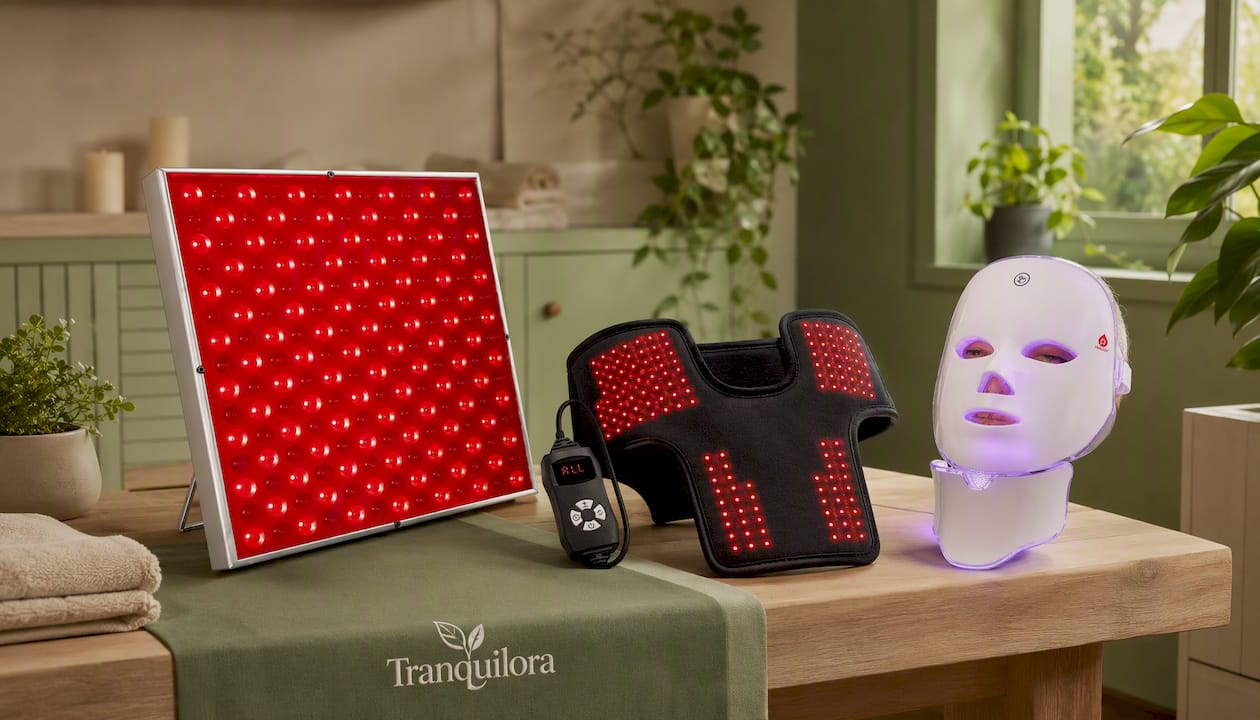
Tranquilora’s Premium LED Red Light Therapy Panel offers wide-area coverage suited to skin and recovery routines across the body, and works well for households that want one device serving several wellness goals rather than a dedicated scalp tool. Because panels deliver light remotely rather than parting hair, they tend to pair best with a hair-focused device rather than replace one.
The Premium 7-in-1 LED Face & Neck Light Therapy System is worth mentioning for readers who want combined facial and adjunctive scalp-adjacent use, though it’s built primarily around face and neck contours rather than optimized scalp dosing, so it functions better as a complementary device than a primary hair tool.
For those focused on broader recovery alongside any hair routine, the Premium Red & Infrared Light Therapy Shoulder Wrap applies the same red and near-infrared wavelength categories to muscle and joint areas, useful as part of a full recovery setup even though it isn’t designed for scalp application.
When comparing any device, check three things before buying: the stated wavelengths (look for ranges in the 630 to 680 nanometer or 800 to 830 nanometer bands discussed in the clinical literature), the manufacturer’s recommended session time and frequency, and the return policy or warranty in case the device doesn’t fit your routine. Tranquilora’s guide on how to choose a light therapy panel walks through these specs in more detail, and the device comparison page can help you weigh a targeted device against a whole-body panel based on your priorities. For a primer on building a sustainable session schedule, see Tranquilora’s guide on how often to use red light therapy. Browse the full red light therapy collection to compare devices side by side before deciding which fits your routine and your goals.
This article is general information, not a substitute for advice from a qualified doctor. Consult a qualified healthcare professional about your own circumstances before acting on anything here.
Sources
- Clinical Safety and Efficacy of Dual Wavelength Low-Level Light Therapy in Androgenetic Alopecia: A Double-Blind Randomized Controlled Study
- Red light therapy: What the science says - Stanford Medicine
- Low-Level Laser Therapy (LLLT) for Hair Loss - review
- Low-Level Laser Therapy(LLLT) for Hair Loss - ISHRS
FAQ
Does Red Light Therapy for Hair Loss Actually Work?
For people with early to moderate pattern thinning, yes, clinical trials show measurable improvement when devices are used consistently for months. A pooled trial analysis found compliant users gained an average of 28.5 more hairs per square centimeter than the sham group at 16 weeks, though it does not restore hair on scalp with long-dormant follicles.
What Did Matthew McConaughey Use to Stop Hair Loss?
Public reporting on this topic hasn’t disclosed specific verified details about any individual’s personal hair care regimen, and Tranquilora doesn’t have grounds to confirm or characterize a specific public figure’s treatment choices. The broader, well-documented options for pattern hair loss include red light therapy, topical minoxidil, and prescription treatments like finasteride, each with its own evidence base.
Can Red Light Therapy Help with Thinning Hair?
Yes, it’s specifically the population where the strongest clinical evidence exists. Follicles that have miniaturized but remain active respond better to photobiomodulation than follicles in areas that have been fully bald for years, since the therapy prolongs the active growth phase rather than reviving dormant tissue.
How Often Should I Use Red Light for Hair Growth?
Most clinical trials used daily sessions ranging from 10 to 25 minutes, sustained for 16 to 26 weeks before measuring results.
Recommended
- Which Red Light Therapy Device Is Right for You?
- How Often Should You Use Red Light Therapy? A Beginner’s Guide
- How to Choose a Light Therapy Panel at Home
- Red Light Mask Versus Panel: Which Fits You?
This article is for general informational and educational purposes only and is not medical advice. Consult a qualified healthcare professional regarding health conditions or before making significant changes to your wellness routine.