

Filtration plus active sanitation is the recommended approach for regular cold plunge use. Filtration alone removes debris and clouding but does not disinfect water, so pairing a cartridge system with UV, ozone, or a low residual sanitizer matters. For home setups, that typically means a 10 to 20 micron cartridge, steady circulation, and a supplemental disinfectant. Filtration-ready options like the Frostgard Pro Ice Bath Chiller and Isvik Cedar Ice Bath are built with this pairing in mind.
TL;DR:
- Using a 10 to 20 micron cartridge filter with steady circulation and supplemental disinfection effectively manages debris, but microbial risks remain if sanitizer levels are neglected.
- Filtration equipment alone cannot catch bacteria or viruses smaller than one micron, so pairing it with UV, ozone, or chemical residuals is essential for safety.
- Microorganisms like Pseudomonas and Legionella can survive at common plunge temperatures, making regular testing of sanitizer levels crucial for ongoing water safety.
- Proper filter matching requires verifying micron ratings, flow compatibility, and replacement part availability, especially when upgrading or maintaining the system.
- Maintenance routines such as daily pump operation, weekly cartridge cleaning, and periodic water disinfection are key to extending water quality and reducing health risks.
Table of Contents
- What Does Cold Plunge Filtration Actually Remove?
- Which Filter Type Fits a Home Cold Plunge?
- Do You Still Need UV, Ozone, or Chemical Sanitizer?
- How Do You Choose the Right Filtration Setup?
- Maintaining Clean Water Week to Week
- Filtration-Ready Cold Plunge Options From Tranquilora
- Sources
- FAQ
What Does Cold Plunge Filtration Actually Remove?
Mechanical filtration works by physically straining particles out of water as it circulates through a cartridge, sand bed, or filter housing. Micron ratings describe the smallest particle size a filter can reliably capture. A 20 micron cartridge catches visible debris like skin flakes, hair, and dirt. A 10 micron filter picks up finer sediment. Neither one comes close to catching what actually makes people sick.
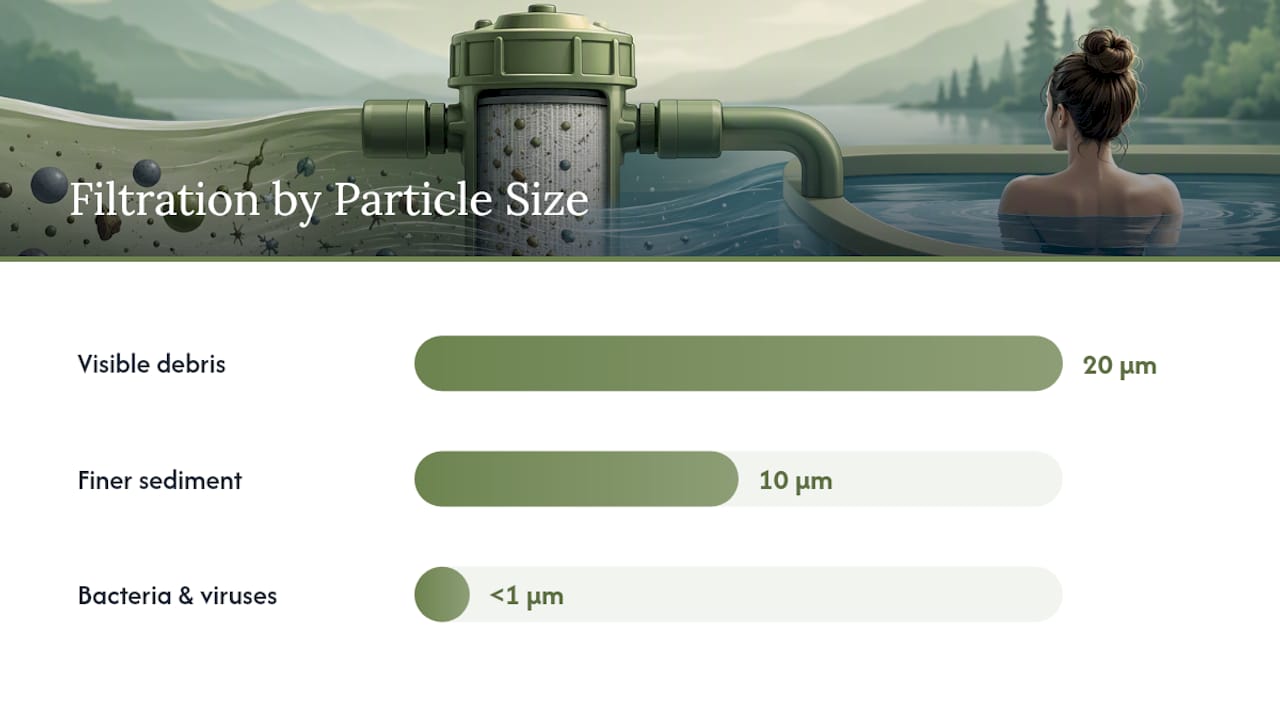
Bacteria and viruses are almost always smaller than a single micron. This is where filtration hits its limit, and it’s a limit worth understanding clearly before you plan your setup.
The National Collaborating Centre for Environmental Health notes that pathogens like Pseudomonas aeruginosa can survive and even reproduce at temperatures as low as 39°F, while Legionella thrives in the 68 to 113°F range that shared plunge water can drift toward between sessions. Cold water slows microbial growth. It does not stop it, and it certainly doesn’t kill anything already present.
That gap between “looks clean” and “is safe” is the single most important thing a new cold plunge owner needs to grasp. Water can run crystal clear through a well maintained filter and still carry bacteria a filter was never designed to catch.
What a standard home filter does and doesn’t do:
- Removes visible debris, skin cells, hair, and sediment down to its rated micron size
- Reduces cloudiness and keeps circulation lines from clogging
- Does not inactivate bacteria, viruses, or most protozoa
- Does not provide any residual protection between filtration cycles
The clarity trap: Clear water is not the same as sanitized water. A filter can pull every visible particle out of your plunge and leave behind exactly the kind of cold-tolerant bacteria that public health guidance flags as a real concern for shared or infrequently drained tanks.
Which Filter Type Fits a Home Cold Plunge?
Three filtration types show up across the cold plunge market, and each one serves a different scale of use.
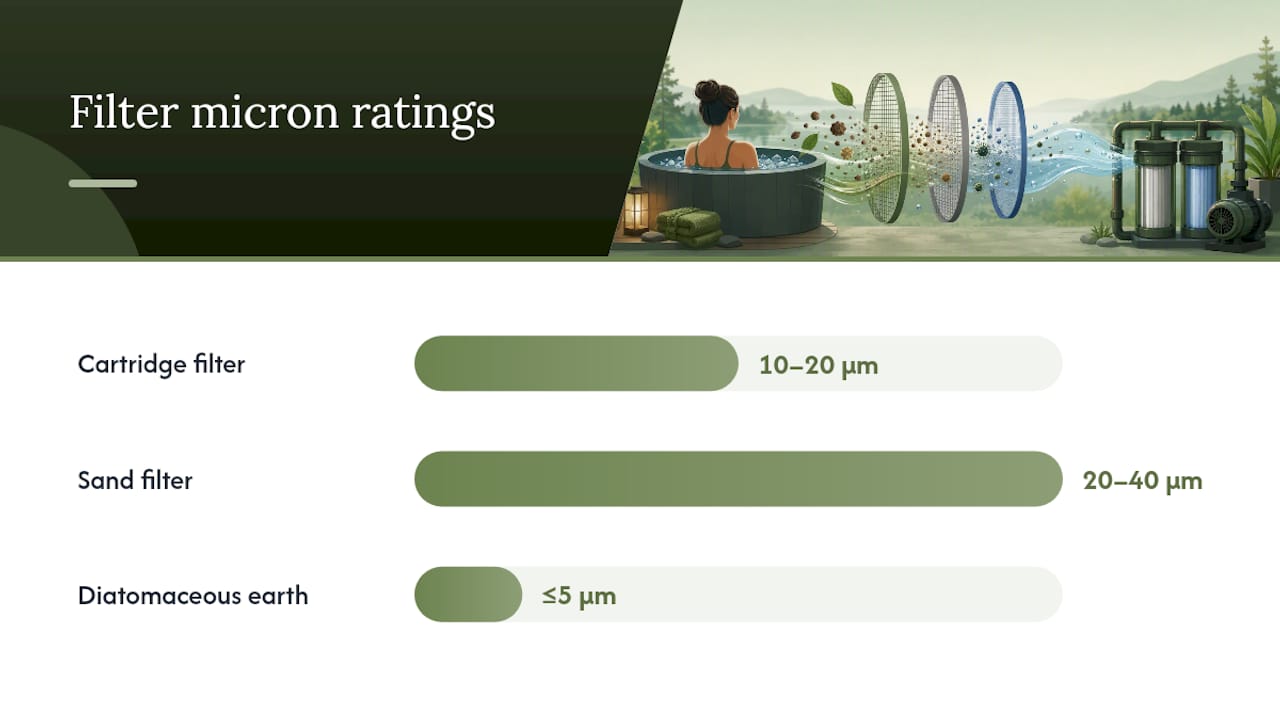
- Cartridge filters are the standard choice for residential plunges. Water passes through a pleated fabric or paper element housed in a canister, usually rated between 10 and 20 microns. They’re compact, relatively inexpensive to replace, and easy for a homeowner to service without tools. Expect to clean the cartridge weekly and swap it out every one to three months depending on use.
- Sand filters push water through a bed of graded sand, catching particles down to roughly 20 to 40 microns. They handle higher water volumes well, which makes them common in commercial and multi-user recovery facilities, but they’re bulkier and less practical for a single home tub.
- Diatomaceous earth (DE) filters offer the finest filtration of the three, sometimes down to 5 microns or less, using a powdery mineral media coated over a filter grid. They deliver the clearest water of the group, but they demand more hands-on maintenance, including regular backwashing and media recharging.
For most residential plunges, a 10 to 20 micron cartridge strikes the right balance between water clarity and manageable upkeep. Going finer than that raises cost and maintenance frequency without a proportional benefit, since the pathogens you actually need to worry about are still too small for any of these mechanical filters to catch on their own.
Pro Tip: Check that any replacement cartridge you buy matches both the micron rating and the physical dimensions of your original housing. A cartridge that’s rated correctly but sized wrong will bypass water around the edges instead of through the media, which defeats the point of filtering at all.
Before buying a housing, confirm it’s rated for your pump’s flow rate in gallons per minute. A mismatch here is one of the more common and avoidable setup mistakes.
Do You Still Need UV, Ozone, or Chemical Sanitizer?
Yes, and this is the piece filtration marketing tends to gloss over. UV and ozone systems are effective at neutralizing microorganisms as water passes through them, but neither one leaves behind a lasting residual once that water moves on. The NCCEH’s guidance on cold plunge tanks is direct on this point: UV and ozone are supplemental treatments, not standalone solutions, and public health guidance recommends pairing them with a residual disinfectant like chlorine or bromine.
Here’s how the main supplemental methods stack up:
- UV-C systems inactivate microorganisms as water flows past a UV lamp. Effectiveness depends heavily on water clarity and flow rate, since cloudy or turbid water can significantly reduce UV performance, which is exactly why upstream filtration matters even though it isn’t the disinfectant itself.
- Ozone generators oxidize contaminants and can reduce chemical demand substantially, but ozone breaks down quickly and offers no lasting protection once generation stops.
- Chlorine or bromine at low residual levels provide the continuous protection that UV and ozone cannot, since some disinfectant remains active in the water between treatment cycles.
UV-C reduces chemical demand significantly in some premium tubs, which is a real comfort benefit for people sensitive to chlorine smell or skin irritation. It’s a reduction, not a replacement. A low residual chemical backup is still the piece doing the ongoing work.
Temperature adds another wrinkle. Chlorine reacts more slowly in cold water, so a dose that would sanitize a warm pool quickly may need more contact time in a 50°F plunge. Many operators land on a combination approach, filtration, plus UV or ozone, plus a modest chlorine residual, specifically because cold temperatures blunt chlorine efficacy enough that relying on one method alone leaves gaps. That’s also why testing strips matter more in a cold plunge than they might in a heated pool. You genuinely can’t eyeball whether the sanitizer is still doing its job.
For anyone weighing chemical handling risk, note that ozone requires proper venting and gas handling precautions, while chlorine and bromine carry standard skin and eye irritation considerations at higher concentrations. Neither is dangerous when dosed conservatively and monitored, but neither should be treated casually either.
How Do You Choose the Right Filtration Setup?
Matching a filtration system to your actual plunge takes more than picking whatever cartridge is cheapest online. Work through this checklist before you buy anything:
- Plumbing type: Confirm whether your tub uses a dedicated circulation loop or a simpler pump-and-return setup, since this determines which housings will physically fit.
- Pump flow rate: Match your filter housing’s rated capacity to your pump’s GPM output. An undersized housing restricts flow and shortens pump life.
- Housing size and micron rating: For most single-user residential tubs, a 10 to 20 micron cartridge housing sized for your water volume is the sensible default.
- UV or ozone compatibility: Check whether your plumbing has room, and power access, for an inline UV or ozone module if you plan to add one later.
- Replacement cartridge availability: Confirm the manufacturer or a third party stocks replacement cartridges before you commit, not after your first one clogs.
When you’re talking to a vendor, a few direct questions separate a genuinely sound system from a vague one:
- How many filtration stages does the system include, and what’s the micron rating at each stage?
- What’s the recommended daily run time for the circulation pump?
- How often should the cartridge be cleaned versus fully replaced?
- What does the warranty cover if a pump or housing fails due to normal water-care use?
If you’re plunging solo a few times a week, a single cartridge stage with a UV add-on is usually enough. Households sharing one tub across multiple people, or running sessions daily, benefit from a slightly more aggressive setup, tighter micron rating, added ozone, and more frequent testing, since more bodies in the water means more organic load for the system to manage.
Watch for a few red flags while shopping: listings that advertise “multi-stage filtration” without specifying any micron rating at each stage, filter housings with no identifiable manufacturer replacement parts, and sanitation guidance that’s vague about testing frequency or residual levels. Component sourcing matters here too. Retailers like Pure Wave Water that specialize in filtration hardware can be a useful resource if you need replacement cartridges or components outside your original vendor’s catalog.
Maintaining Clean Water Week to Week
A cold plunge that gets regular use needs a rhythm, not a one-time setup. Here’s a sequence that keeps most home systems in good shape:
- Run the pump daily, ideally for a few hours after each use, so filtration actually gets a chance to work on suspended debris while it’s still fine enough to capture.
- Test sanitizer and pH two to three times a week using standard test strips, more often with heavier or shared use.
- Rinse or backwash the cartridge weekly to clear trapped debris before it restricts flow.
- Replace the cartridge every one to three months, depending on use frequency and what the manufacturer specifies for your model.
- Drain and fully disinfect the tank periodically, even with active filtration, since filtration paired with sanitation typically extends water life to several weeks, versus the 3 to 7 days often needed without any filtration at all.
If you notice reduced flow from the return jets, check the pump intake and clean the cartridge first; a clogged filter is the most common cause. Cloudy water despite normal chemistry readings usually means the current micron rating isn’t fine enough for your bather load, and a persistent musty or sulfur-like odor is a sign to stop using the tub, drain it, and disinfect the shell before refilling.
Pro Tip: Keep a simple log of your test strip readings and cartridge swap dates. It takes thirty seconds and makes it far easier to spot a pattern, like water clouding up faster every August, before it becomes a bigger cleaning job.
Call a service technician if you notice a sustained bad smell that doesn’t clear after draining and disinfecting, a pump that won’t hold pressure, or chemistry readings that won’t stabilize even after a full water change.
Filtration-Ready Cold Plunge Options From Tranquilora
Choosing the right cold plunge starts with knowing which models actually support the filtration and sanitation setup this guide walks through, rather than leaving you to retrofit one after the fact.
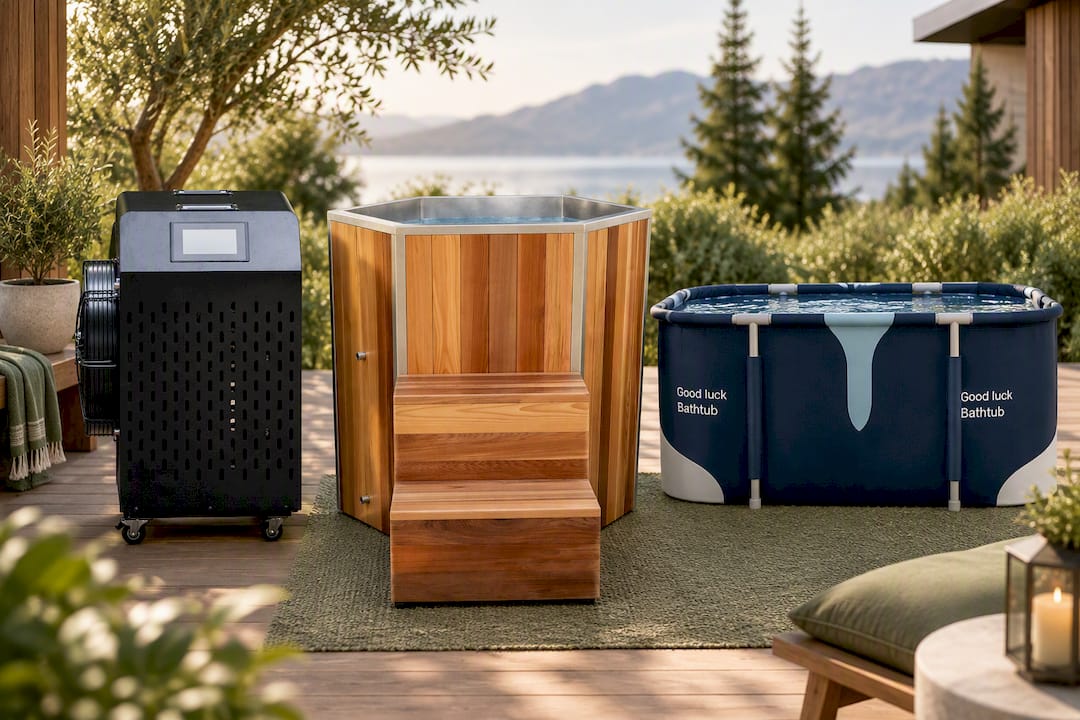
The Frostgard Pro Ice Bath Chiller is built around active circulation, which is the foundation any filtration or UV add-on depends on to actually clean the water passing through it. For homeowners who prefer a natural wood basin, the Isvik Cedar Ice Bath pairs traditional cedar construction with plumbing designed to accommodate an external filter housing. And if space or portability is the priority, the Premium Portable Foldable Recovery Tub offers a compact setup that still works with add-on filtration modules for owners who move their plunge between a garage and a patio seasonally.
Each product page lists compatible filter housings and recommended add-ons, so check those specs against the checklist above before you buy. If you’re unsure which setup fits your space or household size, consult installation guidance and warranty information available for water-care components. Browse the full saunas and cold plunges collection to compare filtration-ready models side by side, or start with the Frostgard Pro if you already know circulation and filtration compatibility are your top priorities.
Sources
- Cold plunge tanks: considerations for environmental public health (NCCEH, April 2024)
- How to keep cold plunge water clean (Cold Plunge Science)
This article is general information, not a substitute for advice from a qualified doctor. Consult a qualified healthcare professional about your own circumstances before acting on anything here.
FAQ
Does a Cold Plunge Need a Filter?
A filter isn’t strictly required for a single-use tub you drain after every session, but for regular or shared use, it’s strongly recommended. Filtration removes debris and extends water life, though it must be paired with a sanitizer since it doesn’t kill bacteria or viruses on its own.
What Happens After 30 Days of Cold Plunge Use Without Proper Care?
Without filtration and sanitation, water quality degrades quickly, often needing a full change every 3 to 7 days. With both in place, many owners can stretch that interval to several weeks, but skipping testing during that stretch raises the risk of bacterial buildup regardless of how clear the water looks.
What Is the Best Filter for a Cold Plunge?
For most residential setups, a 10 to 20 micron cartridge filter paired with steady circulation is the practical standard. The right choice depends on your pump’s flow rate and housing size, which is why checking compatibility specs on filtration-ready models like the Frostgard Pro Ice Bath Chiller matters more than chasing the finest micron rating available.
What Does Joe Rogan Use for His Cold Plunge?
Specific details about individual public figures’ personal cold plunge setups aren’t reliably documented or verified, so this article won’t speculate on a particular product or brand. What’s well established is the general approach: filtration paired with active sanitation, whether UV, ozone, or a residual chemical, is the setup that public health guidance supports for regular use.
How Much Electricity Does a Cold Plunge Use?
Electricity use depends mainly on the chiller compressor and pump, and varies by model, insulation, and how often the unit cycles to maintain temperature. Specific operating costs aren’t listed publicly for every model, so check the product specifications on your chosen tub, such as the Frostgard Pro Ice Bath Chiller, for its own energy estimates.
Recommended
This article is for general informational and educational purposes only and is not medical advice. Consult a qualified healthcare professional regarding health conditions or before making significant changes to your wellness routine.